
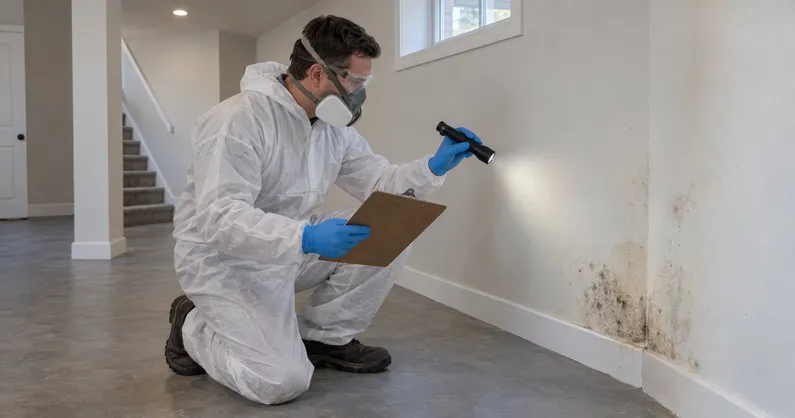
Mold inspection, mold testing, and mold remediation are related services, but they do not answer the same question. An inspection finds and scopes the building problem. Testing analyzes selected samples. Remediation corrects the moisture condition and cleans or removes affected materials.
Most homeowners do not need to order every service in that order. If visible mold is already growing around a leak, testing may not change the need to correct the water source and address the damaged material. If there is a musty odor but no visible source, an inspection may be the right first step. If a physician, insurer, property transaction, legal matter, or written remediation protocol requires a defined result, targeted sampling may add useful information.
The best decision is not the one that produces the most reports. It is the one that answers the next practical question without delaying moisture control or cleanup.
Mold inspection, testing, and remediation at a glance
| Service | Main question | Typical work | What it does not do |
|---|---|---|---|
| Mold inspection or assessment | Where is the moisture or suspected growth, and how far might it extend? | Reviews water history, odors, visible conditions, materials, likely hidden areas, and moisture patterns | Does not automatically include laboratory samples or cleanup |
| Mold testing or sampling | What was present in the selected air, surface, or material sample at the time it was collected? | Uses a planned sampling method and laboratory analysis to answer a defined question | Does not find every hidden area, establish a universal safe level, repair moisture, or remove mold |
| Mold remediation | How will the moisture source and affected materials be corrected safely? | Controls the work area, removes or cleans materials, manages debris, dries the structure, and verifies completion | Does not succeed if the leak, humidity, condensation, or drainage problem remains |
These stages can overlap. A remediation contractor normally assesses the property before writing a scope. An inspector may recommend testing only after identifying a specific reason for it. A post-remediation evaluator may review the completed work visually and, when the project calls for it, collect samples after cleanup.
What a mold inspection should accomplish
A useful mold inspection is a building investigation, not a quick glance at one dark spot. The objective is to understand the conditions that allowed growth and decide what area needs attention.
The inspection may consider:
- Where and when a leak, flood, overflow, roof failure, or humidity problem occurred
- Whether the moisture source is active, intermittent, or already repaired
- Visible growth, staining, deterioration, and musty odor patterns
- The path water may have followed behind walls, under floors, or through ceilings
- Materials likely to trap moisture, such as drywall, insulation, carpet, cabinets, and subflooring
- Adjacent rooms, levels, or cavities that could be affected
- Occupant access, vulnerable people, contents, and practical containment needs
- Whether a plumber, roofer, HVAC contractor, electrician, or another specialist must correct the source
Inspection tools should support that investigation. Visual examination and raking light can reveal surface texture and residue. Moisture-measuring equipment can help compare suspect materials and map a water path. Thermal imaging may help identify temperature patterns worth investigating, but it does not identify mold by itself. Opening a wall is not the first move when less destructive evidence can narrow the location.
The EPA explains that mold assessment is mainly a visual inspection of places with moisture problems or water damage. When hidden growth is suspected, the inspection should be planned carefully because disturbing wallpaper, drywall, insulation, or another concealed surface can release contamination into the room.
If the concern began after a leak or flood, the guide to what homeowners should expect during mold remediation after water damage explains how moisture assessment connects to containment, removal, cleaning, and drying.
What mold testing can and cannot tell you
Mold testing is not one universal procedure. A professional may collect air samples, lift or tape samples from a surface, swab a defined area, or send a small material sample to a laboratory. The sampling plan should identify the question, locations, method, controls, and how the result will be interpreted before anything is collected.
A properly designed test may help:
- Characterize an uncertain substance or a specific affected material
- Compare selected indoor and outdoor conditions when that comparison is relevant
- Investigate a defined hidden-source question after the building has been assessed
- Support a physician’s request in a diagnosed respiratory fungal-infection case
- Document conditions for a written protocol, dispute, transaction, or insurance process
- Provide post-remediation data when the scope or an independent evaluator requires it
Testing cannot prove that every room or cavity is free of mold. It cannot show what conditions were present weeks before collection. It cannot repair a leak, define the full demolition boundary by itself, or turn a single spore count into a health diagnosis.
The CDC does not recommend routine air sampling during building air-quality evaluations. It notes that short-term spore or colony measurements cannot be interpreted against health risk because no health-based indoor-air standards exist. The EPA likewise says that no federal limits for mold or mold spores have been set.
That is why an inexpensive home test kit can create more confusion than clarity. Mold spores are common indoors and outdoors, so finding some mold in a plate or sample is not the same as locating a building problem. Without a defined question, a representative sampling plan, building context, and qualified interpretation, the result may not tell a homeowner what to repair or clean.
When visible mold usually makes pre-remediation testing unnecessary
If growth is plainly visible, the next question is usually not “Is any mold present?” The practical questions are:
- What kept this material wet?
- How far does the affected area extend?
- Which materials can be cleaned and which must be removed?
- How will the work be contained?
- How will the structure be dried and checked before repairs?
Massachusetts public-health guidance says paying to sample for the presence of mold is not usually recommended. Visible mold should be addressed regardless of type, and a careful inspection of the work area is typically more useful. The state also notes that neither the EPA nor the Massachusetts Department of Environmental Protection has set an indoor mold-spore limit.
Skipping unnecessary sampling does not mean skipping assessment. A small visible patch may be the edge of a larger wet cavity. A stain below a roof leak may connect to wet insulation or framing above it. A basement corner may reflect condensation, foundation seepage, poor drainage, or water traveling from another room.
For an upper-level leak, review the warning signs that mold may have spread behind walls after roof damage before disturbing the surface.
When targeted testing may be worth considering
Testing is most useful when the result can change a real decision. Before authorizing samples, ask, “What will we do differently based on each possible result?”
Situations that may justify a targeted plan include:
- A musty odor or occupant complaint remains after a careful inspection cannot locate the source
- Suspected growth is hidden and the least disruptive investigation has not answered the question
- A treating medical professional requests environmental information for a diagnosed condition
- A buyer, seller, landlord, insurer, attorney, or project specification requires defined documentation
- The material is uncertain and identification would change handling or scope
- An independent post-remediation evaluation is required by the project or chosen by the property owner
The Massachusetts Department of Public Health says it does not recommend testing as part of routine water-damage remediation in public buildings. Its guidance identifies limited circumstances where sampling may be considered, including persistent concerns after moisture correction and cleanup or a treating provider’s request related to a diagnosed respiratory fungal infection. Home projects differ, but the same decision principle is useful: test to answer a defined question, not simply because testing is available.
If a person has symptoms, the building contractor should not diagnose the cause or interpret a sample as medical advice. Discuss symptoms and medical testing with a qualified healthcare professional. Separately, have the property evaluated for moisture and visible or hidden damage.
What professional mold remediation adds
Remediation begins after the affected conditions and scope are understood. It is the action stage, not another name for testing.
A professional mold remediation service may include:
- Correcting or coordinating repair of the moisture source
- Defining the work zone and protecting unaffected areas
- Establishing containment and HEPA-filtered air control when the scope requires it
- Removing mold-damaged porous materials that cannot be restored
- Cleaning salvageable framing and other suitable surfaces
- Bagging and moving debris through a controlled route
- Drying the structure and monitoring material moisture
- Cleaning the work area and documenting the completed scope
- Coordinating repair or reconstruction after the area is ready
The sequence matters. Removing stained drywall while leaving wet insulation, an active roof leak, high indoor humidity, or foundation seepage unresolved is not a complete solution. The EPA’s basic mold cleanup steps begin with fixing the water problem and drying materials, then cleaning or removing affected items based on what they are made of.
Remediation also needs to match the source. Mold following a clean plumbing leak is not managed exactly like mold on materials affected by sewage, outdoor floodwater, or another contaminated source. Those conditions can add sanitation and material-removal requirements beyond ordinary mold cleanup.
How to choose the right first step
Use the condition you can verify, not the most alarming possibility.
You see mold and know the moisture source
Arrange an assessment of the affected extent and correct the source. Ask whether testing would change the remediation scope. In many visible-growth cases, it will not.
You smell mold but cannot see it
Begin with a careful building and moisture inspection. Avoid cutting into walls or running fans across a suspect area before the contamination path is understood.
You recently had water damage but see no mold
Confirm that affected materials were completely dried and that hidden layers were checked. Testing is not a substitute for moisture verification. Continue watching for staining, odor, swelling, deterioration, or recurring humidity.
A transaction, insurer, or written protocol requires documentation
Ask exactly what inspection, sampling method, report, laboratory, evaluator independence, and clearance criteria are required before authorizing work. Requirements vary, and a generic home test may not satisfy the party requesting documentation.
Someone in the property has health concerns
Keep the medical and building questions separate. A healthcare professional evaluates symptoms. A building professional evaluates moisture, damage, and remediation needs. Share relevant information between them only as appropriate and authorized.
Questions to ask before hiring an inspector or remediator
Massachusetts does not provide an indoor mold concentration that a contractor can use as a universal pass or fail number. The value of the work therefore depends heavily on the professional’s method, documentation, and explanation.
Ask prospective providers:
- What question will this inspection or test answer?
- Will you investigate and document the moisture source?
- Which areas and materials will be inspected, and why?
- If you recommend samples, how were the locations and methods chosen?
- Which laboratory will analyze them, and how will the results be interpreted?
- Will the result change the remediation plan?
- How will affected and unaffected areas be separated during disruptive work?
- What materials are expected to be cleaned, removed, dried, or repaired?
- How will completion be verified and documented?
- If independent post-remediation verification is needed, who will perform it?
A clear proposal should distinguish assessment, optional sampling, remediation, reconstruction, and third-party verification. It should also explain assumptions. No responsible provider can know every hidden condition before access is created.
Mold assessment and remediation in Massachusetts and Rhode Island
Homes across Massachusetts and Rhode Island face mold conditions after burst pipes, roof leaks, appliance failures, basement moisture, storm water, plumbing leaks, and humid weather. The right response depends on the source, affected materials, visibility, occupant needs, and documentation requirements.
First Response Restoration provides mold testing, assessment, and remediation for homes and businesses. Our IICRC technicians investigate moisture conditions, explain whether testing would answer a useful question, control affected work areas, remove contaminated materials when needed, clean and dry the structure, and document the work.
For help near our Bridgewater base, see mold remediation in Bridgewater. Property owners farther south can review our Plymouth mold remediation service. Call (774) 670-5912 for a free estimate or emergency dispatch.
Frequently asked questions
A mold inspection examines the building for visible growth, moisture sources, water-damage history, odors, and areas where contamination may be hidden. Mold testing collects air, surface, or material samples for laboratory analysis. Testing can add specific information, but it does not replace the physical inspection or identify and repair the moisture source.
Usually not. EPA and Massachusetts guidance says sampling is generally unnecessary when mold growth is visible because the priority is to define the affected area, correct the moisture problem, and clean or remove damaged materials. Testing may still be considered when its result would change a medical, legal, transaction, or remediation decision.
A sample result alone cannot establish that a home is safe or unsafe. There are no federal or Massachusetts health-based limits for indoor mold concentrations, and short samples represent only the conditions during collection. Results need context from a building inspection, moisture findings, occupant concerns, sampling design, and the question the test was intended to answer.
Post-remediation sampling may be useful when a written protocol, insurer, property transaction, legal matter, or project stakeholder requires it, or when an independent professional determines that results will answer a defined question. Visual cleanliness, removal of affected materials, moisture correction, and dry conditions still matter because a laboratory result cannot replace a complete physical verification.
Start with an experienced professional who can assess the water history, moisture source, odors, visible conditions, and likely hidden areas without unnecessary disturbance. Explain whether you see growth, smell a musty odor, recently had water damage, have a pending property transaction, or need documentation. Those facts help determine whether inspection, targeted testing, remediation, or another trade should come first.


